Finding the ROI: How Reveon Health Contract Benchmarking Pays for Itself

Most independent practices do not lose money because they are “bad at medicine”. They lose money in the quiet ways.
A couple dollars underpaid on a common office visit. A contract renewal that basically tracks “cost of living”. A payer rep saying, this is our standard fee schedule, and everyone sort of shrugging because… what else can you do?
Except you actually can do something. You can walk in with numbers that are hard to ignore.
That is the whole point of Reveon Health. It is a healthcare rate analytics platform built to give independent providers and the businesses that support them access to regional rate benchmarks by payer, filtered down by zip code and specialty, so you can negotiate with real comps instead of vibes.
And it is priced like a tool a normal practice can actually buy. Not a consulting engagement.
Reveon’s monthly plans run $79 to $239 per month, depending on what level of access you need.
The question is simple.
Does it pay for itself?
The problem: contract negotiation without comps is basically guesswork
If you have ever negotiated a payer contract as an independent practice, you know the pattern:
- You ask for an increase.
- The payer asks why.
- You say your costs are up.
- They offer something small. Often tied to CPI, sometimes even less.
- Everyone moves on.
That “cost of living bump” might be 2% to 4% in a decent year. Meanwhile your staffing costs can jump 8% to 15% and your rent is not exactly chilling out either.
The hard part is not asking. The hard part is proving you are being paid under market for your area, your specialty, and your peer group.
That is where benchmarking earns its keep.
What Reveon Health actually gives you (and why it is different)
Reveon Health’s core value is not “analytics” in the abstract. It is contract benchmarking you can actually use.
Specifically, it gives you access to:
- Regional rate benchmarks for various payers
- Benchmarks you can filter by zip code and specialty
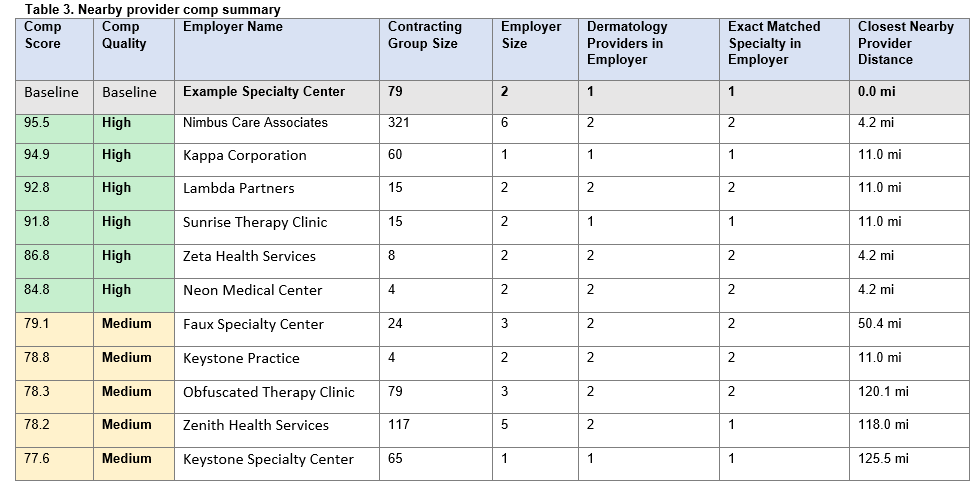
- Reporting you can use to identify local comps, including comparisons tied to real world identifiers like NPIs, EINs, and employers
So instead of negotiating like, “We think we should be paid more”, you can negotiate like:
“Here are the contracted rates in our zip code for our specialty with this payer. Here are comparable providers and organizations by geography and employer size. Our current schedule is X% below market on the codes that make up most of our volume. We need to be brought to at least the local benchmark range.”
That is a completely different conversation.
And crucially, it is not locked behind a $20k consulting project.
Reveon’s model is a monthly subscription. Again, $79 to $239 per month.
That pricing matters because it changes who gets access to negotiation leverage. Independent practices. Small groups. Billing and RCM companies supporting multiple clients. The folks who normally get told to accept what they are given.
What “ROI” means here, really
When people think of ROI, they often think “saving money”.
However, contract benchmarking is about making money you are currently leaving on the table.
And the ROI tends to come from three buckets:
- Higher allowed amounts on your highest volume CPT codes
- Avoiding weak renewals that quietly lock in under market rates for years
- Negotiating smarter by focusing on the codes and payers that actually move revenue
Let’s make it tangible.
The simplest ROI math (and why it gets big fast)
Here is a quick example to illustrate the math.
Example: a 10% rate increase on 99213 for one payer
Assume:
- You are a primary care practice
- One payer represents 10% of your total visits
- You bill CPT 99213 frequently (as most primary care practices do)
- You negotiate a 10% increase on that code with that payer (this is often very conservative; see our published article in which we identified a national rate variability of 58% of normalized Medicare rate for 99213)
Let’s put rough numbers around it.
Volume assumption (conservative):
- 30 total patient visits per day
- 5 days per week
- 48 weeks per year (allowing for holidays, physician vacation, etc.)
- Total visits: 30 × 5 × 48 = 7,200 visits/year
If 10% are that payer, that is 720 visits/year for that payer.
If even 50% of those are 99213 (again, conservative for some practices), that is:
- 720 × 50% = 360 claims/year for 99213 to that payer
Now, if your current allowed amount for 99213 with that payer is, say, $90 (placeholder number), then:
- Current revenue: 360 × $90 = $32,400
- With a 10% increase: $99 allowed
- New revenue: 360 × $99 = $35,640
Incremental annual revenue: $3,240
From one CPT code. A single provider. One payer. A payer that is only 10% of your volume.
Now compare that to Reveon’s cost.
Even the most expensive monthly plan is $239/month = $2,868/year.
So one code, one payer, modest volume, you already cleared the subscription cost. And most practices do not have just one negotiable code.
That is why benchmarking is one of those tools where the ROI can be weirdly lopsided.
The bigger win: negotiating based on your top codes, not generic “fee schedule” talk
Here is where practices usually mess up negotiations, even smart ones.
They negotiate “the contract” as if every CPT code matters equally.
It does not.
You want to target the codes that drive your revenue. Which means you need to combine two things:
- Your utilization data (what you actually bill)
- Benchmark rates (what you should be paid in your area)
Your utilization data is already in your world. It is sitting in your EMR and your billing system.
So the workflow becomes pretty straightforward, even if it feels a little tedious the first time:
Step 1: Pull a CPT utilization report from your EMR
Most EMRs can export something like:
- CPT code
- Count / frequency
- Payer mix
- Allowed amount (if you have it)
- Charge amount
- Date range (last 6 or 12 months is usually enough)
If you have a biller or RCM team, they’re probably looking at this already.
You do not need perfection. You need direction.
Step 2: Identify your “top 10” CPT codes by volume and by revenue
For a primary care practice, you might see:
- 99213, 99214
- 99395 to 99397 (annual visits)
- 90686 (flu vaccine) or other immunization administration codes
- 80061 (lipid panel), etc.
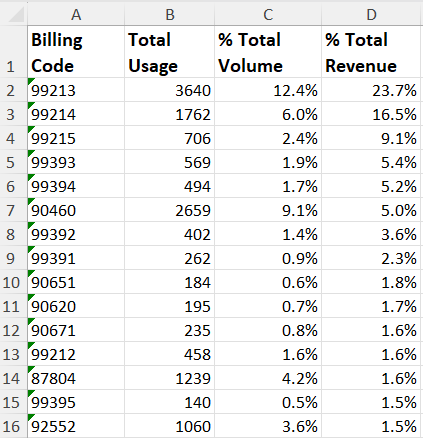
For ortho, maybe 20610, 29881, imaging reads, etc.
The specific list is not the point. The point is you stop negotiating blindly.
It’s essential to remember that while you’re focusing on these top codes, the negotiation process isn’t just about securing higher reimbursement rates. It’s also about understanding the broader context of these negotiations. For instance, the recent final rule guidance from Medicaid provides valuable insights into how reimbursement rates are structured and what factors influence them. This knowledge can empower you during negotiations, allowing you to advocate more effectively for your practice and secure the best possible outcomes for your top codes.
Step 3: Use Reveon Health to benchmark those CPT codes by payer, zip, and specialty
This is where Reveon is built to help.
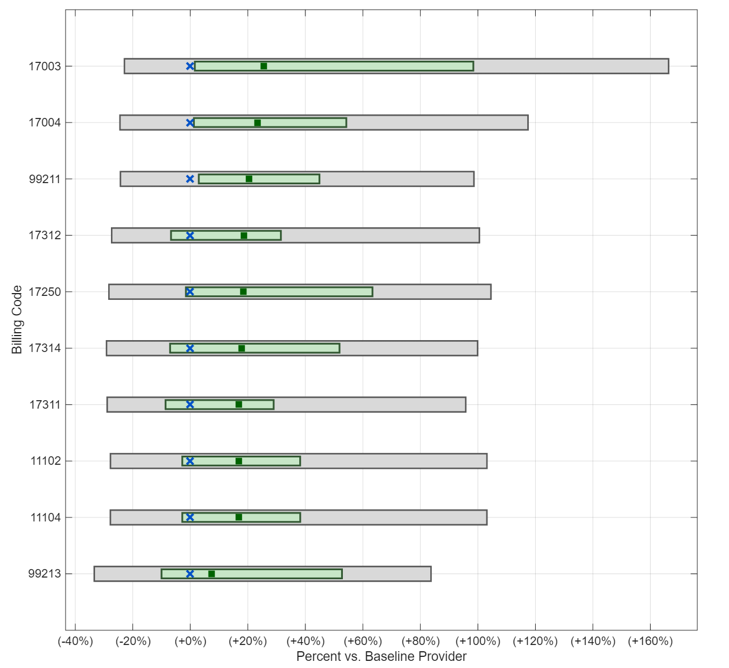
You can look at regional rate benchmarks for various payers, filtered down by zip code and specialty, and then pull billing code-specific reporting that supports what you are about to claim in a negotiation.
Now, instead of asking for a flat 10% across the board (which payers often resist), you can say:
- “On 99213 and 99214 we are materially below the local benchmark range, 18% below the peer median.”
- “These two codes represent 35% of our total billed volume to your plan.”
- “Here are local comps with same specialty and similar practice size.”
It becomes a business conversation. Not a pleading session.
Using comps like a grown up: NPIs, EINs, and employers that match your situation
One of the most practical things about Reveon’s approach is the ability to build a story around comparable entities.
Not “a national average”. Not “what the big hospital gets”. Not “someone on a forum said their rates are higher”.
Actual comps.
When you generate a report that shows specific NPIs, EINs, and employers in your area that match you on the stuff payers care about, negotiations get sharper.
Here is what that can look like in the real world:
Scenario: Independent cardiology group in a specific zip code
You filter by:
- Specialty: cardiology
- Geography: your zip code (and maybe adjacent zips, depending on density)
- Payer: the payer you are negotiating with
Then you pull comps such as:
- Other cardiology NPIs within X miles
- Similar sized employers (so you are not comparing a 2 doc group to a 200 provider system)
- Same payer network, same region
Now your negotiation language changes from:
“We want higher rates.”
to:
“We are currently paid below the benchmark range for cardiology in this zip code. Comparable providers and employers in our geographic market are paid at higher allowed amounts for the same CPT set. Here are the comps and here is our ask, code by code.”
And yes, sometimes you still get pushback. But it is not the same pushback. They cannot just say “no” and move on. They have to explain the gap.
That friction is leverage.
The ROI story most practices miss: renewals lock in underpayment for years
Even if you are not actively negotiating every month, you are always moving toward a renewal.
You might think a 3% increase for the next three years sounds good, since you’ll be getting a solid cost of living raise. If you accept this 3% increase, though, and you were already 20% under benchmark, you are not “stabilizing”. You are locking in a bad position and ensuring lost revenue for years. This is the huge win payer contract negotiators are hoping for.
Reveon’s ROI lets you turn the negotiation table around. It is not only the increase you win today. It is the underpayment you avoid for the next 24 to 36 months.
So when you do the math, do not think in “monthly” terms. Think in contract cycle terms.
A small underpayment across a high volume code is like a drip leak. You barely notice it until you see your water bill. Reveon Health shows you your water bill years in the future.
A more dramatic ROI example (because this happens a lot)
Let’s take a slightly bigger but still realistic case.
Assume a multi provider primary care practice:
- 3 providers
- 18,000 total visits/year combined (not crazy)
- Two big E/M codes dominate: 99213 and 99214
- One payer is 25% of their volume
- They negotiate improvements primarily on those two codes
Let’s say for that payer:
- 99213 increases by $8 allowed
- 99214 increases by $12 allowed
Now assume that payer volume is 4,500 visits/year (25% of 18,000), with the following split:
- 55% are 99213 (2,475 visits)
- 35% are 99214 (1,575 visits)
- 10% are other codes
Incremental revenue:
- 2,475 × $8 = $19,800
- 1,575 × $12 = $18,900
Total incremental from just those two codes: $38,700/year.
Now compare to Reveon:
- $79/month = $948/year
- $239/month = $2,868/year
It is not even close.
And yes, your mileage varies. But this pattern is common. Practices tend to have a handful of codes that carry a huge portion of revenue. When those codes are under benchmark, the “lost” revenue stacks up fast.
Why Reveon’s affordability is a strategic advantage (not just a nice price)
A lot of benchmarking options in healthcare are effectively priced for huge groups, health systems, payers, and consulting firms. They assume you have a dedicated data analytics team who can struggle through Transparency-in-Coverage machine readable file data lakes to produce a customized negotiation report.
Which means independent providers get stuck with either negotiating blind, or paying so much for data that the ROI gets fuzzy.
Reveon’s pricing is clear and refreshing. A monthly subscription from $79 to $239.
So instead of having to “justify” benchmarking, you can treat it like what it is:
A basic operational tool. Like your phone system. Like your clearinghouse. Like your EMR add ons. And you can flexibly change subscriptions with different payers as needed.
And that changes behavior. Practices actually use it. They check benchmarks more than once a year. They run reports when a payer acts weird. They build a negotiation file over time instead of panicking at renewal.
That is where the long term ROI really compounds.
What a Reveon powered negotiation packet can look like
If you are wondering what you actually bring to the payer, here is a practical outline. Not fancy, just effective.
1. One page Executive Summary
Include who you are, patient access stats (optional but helpful), and why you are requesting a rate review.
2. Top CPT utilization snapshot
Pull from EMR or billing reports. Show your top 10 CPT codes by volume and revenue, with payer specific utilization.
3. Comps
Show nearby comparable NPIs, EINs, and employers when relevant. Focus especially on comps that match taxonomy and specialty, employer size and geography.
4. Reveon benchmark pages
Provide benchmarks for the payer in your region, filtered by zip code and specialty. Highlight gaps where you are under benchmark. Focus on your most important CPT and HCPCS codes.
5. Your ask
Present your request code by code, focused on what matters. Alternatively, use a structured request like “bring us to the benchmark range for these codes”.
6. Timeline
State when you want a response and outline next steps.
This is the difference between “asking” and “making a case”.
Who Reveon works best for (in plain language)
Reveon Health is not trying to be everything to everyone. The sweet spot is pretty clear:
- Independent practices that want leverage without paying enterprise prices
- Multi site groups that need regional comparisons across zip codes
- Billing companies and practice support organizations that want a repeatable benchmarking workflow for multiple clients
- Practices that are tired of accepting “standard” increases and want to negotiate with local market context
If your practice has meaningful fee for service exposure, and you have even one payer that is material to your mix, benchmarking tends to show up as real money.
The punchline: this is one of the few subscriptions that can pay for itself with one conversation
You do not need to “boil the ocean” to get ROI from Reveon.
If you use it to win:
- a 10% improvement on one high volume E/M code for one payer, or
- a targeted increase on your top 3 CPT codes, or
- a benchmark based correction that brings you back to local market levels
…you will easily cover the subscription cost.
And then everything else is upside.
Reveon Health believes that independent providers deserve access to the same kind of rate intelligence that bigger organizations have been using for years. But in a way that is actually usable, actually affordable, and actually tied to the way negotiations happen in real life.
If you have been accepting “cost of living” bumps because you did not have the data to argue, that is the gap. That is where the ROI lives.
Next step: a simple way to start without overthinking it
If you want to prove ROI quickly, do this:
- Pull your last 12 months CPT volume by payer from your EMR or billing platform
- Pick one payer you want to renegotiate this year
- Focus on your top 10 CPT codes with that payer
- Use Reveon to pull benchmarks filtered by your zip code and specialty
- Build a small negotiation packet and request a rate review
You are not trying to win everything. You are trying to win something meaningful, on purpose.
That is usually enough for Reveon Health to pay for itself. And then, honestly, it is hard to go back to negotiating blind.
FAQs (Frequently Asked Questions)
What common financial challenges do independent medical practices face in contract negotiations?
Independent medical practices often lose money quietly through underpaid office visits, contract renewals tied only to cost of living increases, and accepting standard fee schedules without negotiation. These small gaps accumulate over time, impacting profitability even if the practice excels clinically.
How does Reveon Health help independent practices improve their payer contract negotiations?
Reveon Health provides a healthcare data analytics platform offering regional rate benchmarks by payer, filtered by zip code and specialty. This allows practices to negotiate contracts using real, local comparable data instead of guesswork or vague assumptions, empowering them to secure better reimbursement rates.
What makes Reveon Health different from traditional consulting services for contract benchmarking?
Unlike expensive consulting projects that can cost upwards of $20,000, Reveon Health operates on an affordable monthly subscription model ranging from $79 to $239 per month. This pricing structure makes advanced contract benchmarking accessible to independent practices, small groups, and billing and RCM companies supporting multiple clients.
What types of data and comparisons does Reveon Health provide to support contract negotiations?
Reveon Health offers detailed reporting including regional rate benchmarks for various payers, filters by zip code and specialty, and comparisons tied to real-world identifiers such as NPIs (National Provider Identifiers), EINs (Employer Identification Numbers), and employer size. This granular data helps identify local comps and market positioning accurately.
How does using Reveon Health translate into a return on investment (ROI) for medical practices?
The ROI comes primarily from capturing revenue currently left on the table through higher allowed amounts on high-volume CPT codes, avoiding weak contract renewals that lock in below-market rates, and negotiating smarter by focusing on impactful codes and payers. For example, a modest 10% rate increase on a common code like CPT 99213 with one payer can generate thousands in additional annual revenue—often exceeding the subscription cost from added revenue from even a single code.
Can you provide a concrete example showing how Reveon Health’s benchmarking leads to financial gains?
Consider a primary care practice with 7,200 visits annually where 10% are from one payer. If 50% of those visits are billed under CPT 99213 at an allowed amount of $90 per visit, the current revenue is $32,400. Negotiating a 10% increase raises the allowed amount to $99 per visit, resulting in new revenue of $35,640—an incremental gain of $3,240 annually from just one code and one payer. Since Reveon’s highest subscription tier costs $2,868 per year, this increase alone more than pays for the service.