What you can do with Reveon
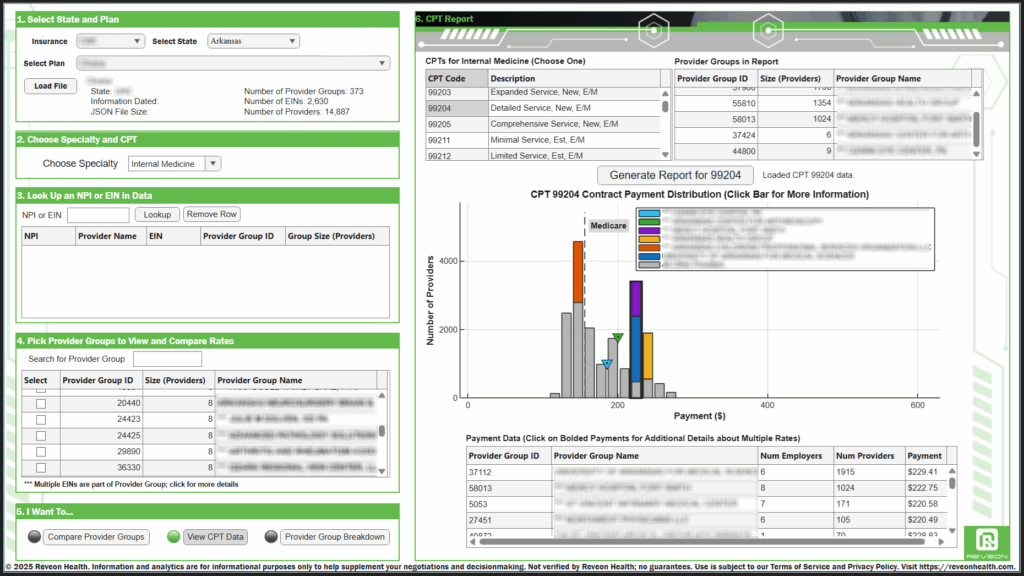
- Benchmark your current rates by payer and CPT; use data to negotiate better payer contracts
- Compare nearby provider groups and hospital-backed competitors
- Evaluate CINs and provider groups before joining
- Identify where you may be under-market
Pricing
- Monthly payer plans from $79/month
- Quarterly payer plans from $149/quarter
- All-payer bundle available


Small Practice Issues
Independent practices face major challenges that inhibit their ability to increase revenue through effective healthcare contract negotiations and dealings with payers.
- Rate Opacity: A fundamental issue is the lack of transparency in insurer rates and contracting terms, severely hindering a practice's ability to benchmark and effectively negotiate with insurance companies.
- Negotiation Difficulty: Small practices struggle significantly with the complexity of healthcare contract negotiations and navigating decision-making regarding joining forces via clinically integrated networks.
- Reimbursement Inequity: The unfairness of reimbursement rates is profound; payment for the exact same service can vary by 5x or more among physicians within the same region, dramatically limiting potential revenue.
- Resource Gap: Small practices must master many business skills but lack the dedicated, full-time business teams that larger hospitals utilize for sophisticated healthcare contract negotiations.
- Negotiation Constraints: While practices often collaborate to improve their leverage to negotiate with insurance companies, they are legally restricted from sharing proprietary reimbursement data, weakening their collective strategy.
Overall healthcare issues
- Rapidly increasing costs of healthcare and insurance prices
- Consolidation of small practices into corporate/hospital-owned businesses that are often local healthcare monopolies
- Becoming increasingly challenging to open and run a practice
- Providers often feel pressured by insurances to treat patient care like factory work
- Healthcare provider burnout