
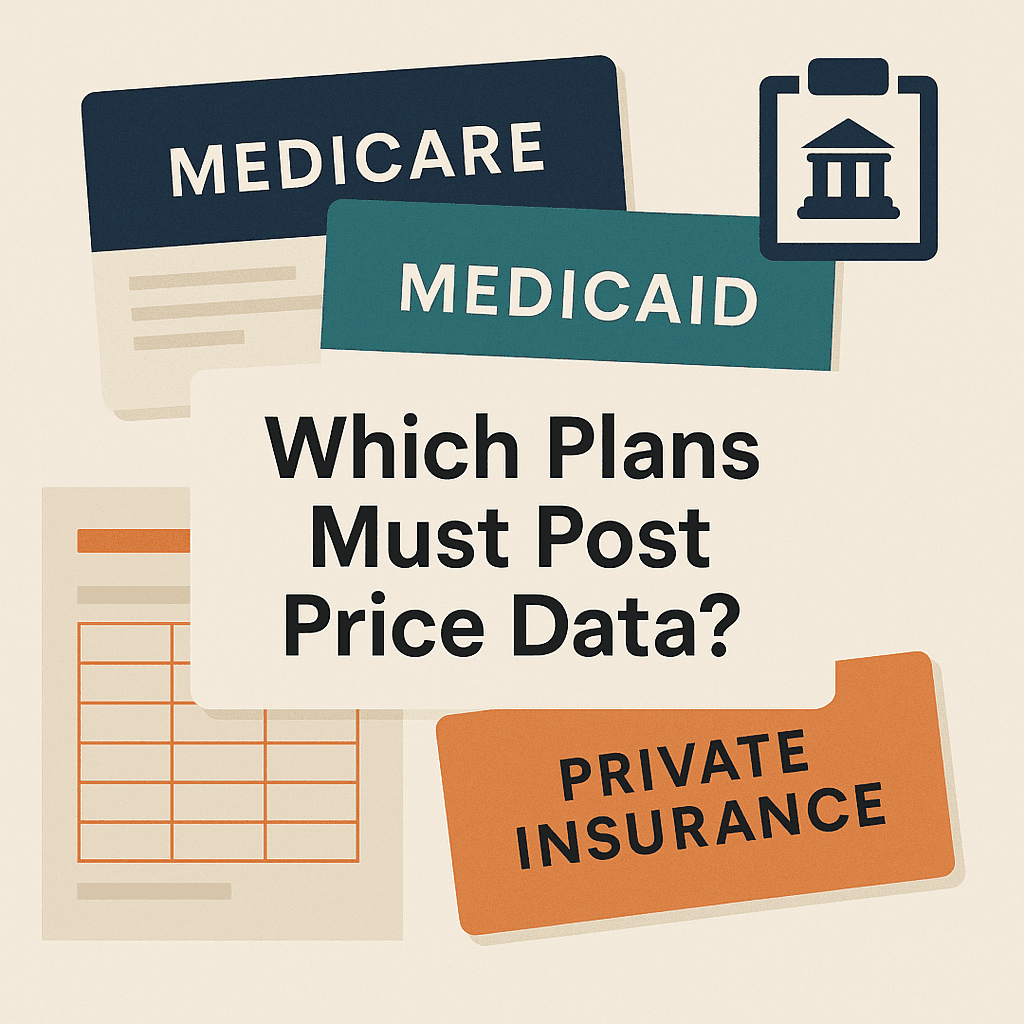
Medicare, Medicaid, and Private Insurance: Which Plans Must Post Price Data?
You might get a fee schedule from a contract (maybe). You might get a remittance sample (sometimes). Or you do what most practices do, you guess based on last year’s mix of claims and a couple of anecdotes from a colleague down the street.
And then Transparency in Coverage shows up and everyone hears, “prices are public now.”
Yes. Sort of. For some plans. In a specific format. With a bunch of exclusions. And a big catch that trips people up.
This article is meant to clear that up.
We are going to walk through which plans must post price data, which ones do not, what “price data” actually means in this context, and how a practice can use it (without downloading a 500GB file and crying into Excel).
Along the way, I will point out where Reveon Health fits in, because honestly, turning TiC files into something you can use in payer negotiations is the whole game.
What “price data” means (because people mix this up)
There are two big transparency rules people confuse:
- Hospital Price Transparency (CMS)
- Hospitals post machine readable files and shoppable services pricing.
- Transparency in Coverage (TiC, federal rule for health plans)
- Health plans post machine readable files with negotiated rates and historical allowed amounts.
This post is about TiC.
Under TiC, when we say “post price data,” we’re usually talking about three machine readable file types (not all plans have to post all three forever, but these are the buckets):
- In network negotiated rates for covered items and services (by billing code and provider or provider group identifier).
- Out of network allowed amounts and billed charges (historical, aggregated).
- Prescription drug pricing files were part of the original rule, but enforcement has been… complicated and delayed, and most provider contracting conversations are about the medical side anyway.
So if you are a medical practice looking for leverage, the in network negotiated rates file is the gold. It is massive, messy, and also full of negotiation intelligence if you can extract it.
The short answer: who must post TiC price data
Most private, commercial health plans must post TiC machine readable files.
Traditional Medicare does not.
Traditional Medicaid generally does not.
Medicare Advantage and Medicaid Managed Care are different. They are run by private insurers under government programs, and they often fall under different transparency expectations and data availability patterns. The key is to know what the TiC rule actually targets: non grandfathered group and individual health insurance coverage and non federal government plans in most cases.
But let’s break it down carefully. Because the devil is always in the plan type.
Plans that generally MUST post TiC price data
1. Fully insured commercial plans (group and individual)
These are your classic products where an insurer bears the risk and sells coverage to employers (group) or individuals (ACA marketplace and off exchange).
If it is non grandfathered, it is generally in scope.
What you can expect in the data:
- Negotiated rates by CPT, HCPCS, DRG, revenue code (depends on the service).
- Provider identifiers, usually NPI and sometimes TINs or other group identifiers.
- Rate arrangements that might be percent of charge, case rate, per diem, capitation, or a fixed dollar amount.
Why it matters to providers: This is where a ton of independent practice revenue lives. And it is also where benchmarking is the most useful because commercial rates vary wildly, even within the same county.
2. Self funded employer plans (ERISA), via a TPA or carrier
This is the part that surprises people.
A self funded plan is the employer’s money. The employer is the plan sponsor. But the plan usually uses a carrier or administrator network (think, the “logo” on the card) and that entity often handles compliance and posts files.
These are typically in scope if non grandfathered.
Two notes that matter in the real world:
- The files might be hosted by the carrier, the TPA, or a third party vendor.
- You will see similar negotiated rates as fully insured products because the plan is accessing the same network contracts in many cases. But not always.
If you negotiate with commercial payers, you are negotiating in a world where self funded lives are a big chunk of volume. So yes. This data matters.
3. Non grandfathered plans (this phrase is everything)
TiC generally applies to non grandfathered health plans.
A “grandfathered” plan is basically an older plan that has not made certain changes since the ACA era, and it gets some exemptions.
In practice, the number of truly grandfathered plans has shrunk over time. So for most providers, this exemption exists, but it does not remove the bulk of commercial coverage from the transparency universe.
Plans that generally do NOT have to post TiC price data (or it is not the same)
1. Traditional Medicare (Original Medicare, Part A and Part B)
Traditional Medicare is a federal program. Pricing is set administratively (fee schedules, DRGs, etc.), and Medicare rates are already “public” in a different sense.
So no, Medicare Part A and Part B are not posting TiC negotiated rate files. There is no “negotiated rate” concept the way there is with commercial payers.
Still, there is a practical takeaway: Medicare often acts like the anchor. Many commercial contracts reference Medicare in their terms, explicitly or implicitly. So Medicare matters for negotiation, but not because TiC files are coming from it.
2. Traditional Medicaid (fee for service Medicaid)
Fee for service Medicaid is state administered, with public fee schedules and state plan amendments.
Again, this is not the TiC framework. And there is no insurer negotiated rate posting requirement like commercial plans.
Some states publish pretty detailed rate information already. Others are harder. But it is a different world.
3. Certain excepted benefits
TiC generally does not apply to “excepted benefits” like:
- Stand alone dental plans
- Stand alone vision plans
- Some short term limited duration insurance
- Certain indemnity products
These are not the typical payer contracts most specialty practices care about when they say “commercial.”
4. Health care sharing ministries and similar arrangements
Not insurance. Not in scope.
5. Federal employee and military related programs (usually)
Programs like TRICARE and certain federal employee health benefits have their own structures. They are not what people mean when they say TiC price files.
The tricky middle: Medicare Advantage and Medicaid Managed Care
This is where people get tangled, because the words “Medicare” and “Medicaid” are in the name. But the payer on the other side is often a commercial insurer.
Medicare Advantage (Part C)
Medicare Advantage plans are offered by private insurers under contract with CMS. They negotiate provider networks and rates, but they are also heavily regulated.
Do MA plans post TiC files?
Often, you will find transparency files associated with the insurer’s commercial compliance. But MA is not always treated the same way as individual and group commercial coverage for TiC obligations.
Practically speaking, you may see MA rates show up in datasets depending on how the insurer structures its disclosures. But you should not assume MA is comprehensively covered the same way a fully insured commercial PPO is.
If your practice is heavily MA, you should treat TiC as a supplement, not the whole answer.
Medicaid Managed Care (MCOs)
Medicaid MCOs are private insurers administering Medicaid benefits under state contracts. Rates and provider reimbursement can be negotiated, but there are also state rules, directed payments, and other mechanisms.
Do they post TiC files?
Again, it is inconsistent. Some disclosures exist, but the TiC rule target is not “all things called insurance.” It is specific to commercial market coverage types.
If you contract with MCOs, you are usually better served by:
- State published MCO reporting (when available)
- Contract terms
- Remit analysis
- Benchmarking in your market from accessible datasets
TiC may help indirectly, especially because the same parent insurer negotiates commercial contracts. But do not expect a clean “Medicaid MCO TiC dataset” to always be sitting there waiting for you.
Who must post what (high level)
| Plan type | Must post TiC in-network negotiated rates? | Notes |
| Fully insured commercial (non-grandfathered) | Yes | Core TiC universe |
| Self-funded employer plans (non-grandfathered) | Yes | Often posted by carrier/TPA |
| ACA marketplace plans | Yes | Typically included |
| Grandfathered plans | Often exempt | Shrinking population |
| Traditional Medicare (A/B) | No | Public fee schedules instead |
| Medicare Advantage | Not consistently treated like commercial | May appear depending on insurer approach |
| Traditional Medicaid (FFS) | No | State fee schedules, not TiC |
| Medicaid Managed Care | Not consistently | State contracts and rules vary |
| Standalone dental/vision | Usually exempt | Excepted benefits |
| Short-term limited duration | Usually exempt | Not ACA compliant coverage |
What exactly gets posted (and what you will not get)
TiC data is powerful, but it is not a magic “here’s your contract” export.
What you usually get
- Negotiated rates tied to billing codes.
- Provider or facility identifiers.
- Billing class and place of service context sometimes.
- Rate types (fee schedule, percent of charge, case rate).
- Sometimes multiple negotiated rate entries for the same code depending on modifier, site, or arrangement.
What you often do not get, at least not cleanly
- The full contract language (timely filing, authorization rules, bundling rules).
- Real adjudication rules.
- Carve outs, value based payment terms, and quality incentives.
- A clear mapping of “this rate is exactly for your tax ID in this product.” Sometimes yes, sometimes not.
So. It is rate intelligence, not full contract replacement.
Why independent practices should care (even if you are not a data person)
Because payer negotiations are often lopsided for one boring reason.
The payer knows the market. You usually do not.
They know what they pay other groups in your area. They know what they can replace you with. They know if your rates are low compared to peers. They walk into the conversation with that context.
TiC makes it possible for providers to walk in with context too. But only if you can actually use the files.
And that is the key shift. Not transparency as a concept, but operationalizing transparency into benchmarks you can defend.
This is basically the lane Reveon Health is going after.
Independent practices should also be aware of the regulation of private health insurance as it plays a significant role in their dealings with payers. Understanding these regulations can provide further context and leverage during negotiations.
The reality check: TiC files are hard to use raw
If you have not opened one of these files before, here is the vibe:
- Gigabytes of JSON
- Millions of rate rows
- Provider references stored in separate objects
- Rates tied to billing codes but not always in the way you expect
- Updates monthly for many issuers
- Hosting links that change, break, redirect, or get reorganized
A normal practice does not have time for that. Even many consultants do not want to do this manually every month.
So the question becomes: how do you turn it into something like,
- “Your 99213 allowed amount is in the 20th percentile for your county and specialty peer set.”
- “Payer X pays 18 percent less than Payer Y for the same code mix.”
- “You are underpaid on these 15 high volume codes and the gap is worth roughly $210,000 annually.”
That’s the language negotiations run on.
How to find TiC files (if you want to verify a payer yourself)
Most insurers publish a “Transparency in Coverage” page with links to machine readable files. Sometimes it is a search tool. Sometimes it is a list of plan names. Sometimes it is a vendor hosted portal.
Things to look for:
- “Machine readable files”
- “In-network rates”
- “Allowed amount file”
- “Transparency in Coverage final rule”
If you are doing this manually, you will quickly realize why a platform approach is nicer.
Still, it is useful to spot check.
So which plans should you actually focus on for contract negotiation?
If your goal is higher reimbursement through commercial renegotiation, the priority list is usually:
- Your top commercial payers by volume and revenue (fully insured plus self funded lives using that network).
- High volume codes and high margin procedures in your specialty.
- The plans where you suspect you are an outlier on rate, either too low or just weirdly inconsistent.
Medicare and Medicaid matter, but they tend to be “rules based” reimbursement, not negotiated. So TiC is less directly helpful there.
If you are mostly Medicare, your biggest leverage might be operational, coding, and payer mix strategy. If you are mostly commercial, TiC benchmarking is a direct line to negotiation preparation.
How Reveon Health fits in (and why it is not just another transparency blog)
The thing Reveon Health is trying to do, and the reason it is relevant here, is simple:
TiC data exists. But it is not accessible.
Reveon turns TiC machine readable files into clear reimbursement benchmark reports so a provider, an RCM group, or a contract negotiation consultant can compare rates without building a data pipeline from scratch.
If you are negotiating with commercial payers, that is the moment you want:
- local benchmarks
- specialty relevant comparisons
- defensible percentile positioning
- documentation you can bring to a payer call, not a raw JSON excerpt
If that sounds like what you have been missing, you can check us out here: Reveon Health. There is a free rate opportunity screen if you want to see the strength of your renegotiation case with payers in your region.
Common questions I hear (quick clarifications)
“If my payer is a big national carrier, does that mean all their plans are covered?”
Not automatically. The carrier might administer commercial, MA, and Medicaid MCO products. TiC obligations attach to specific coverage types. Start with commercial. Treat the rest carefully.
“Are these the actual allowed amounts I will see on my remits?”
They are negotiated rates, but remits can differ due to:
- modifiers
- multiple procedure reductions
- bundling edits
- patient responsibility
- site of service rules
- benefit design and cost sharing
So TiC is best for benchmarking base rates and contract positioning, not predicting exact claim outcomes line by line.
“Can a payer hide their rates?”
They can make them annoying to access, sure. But the rule requires public posting for in scope plans. Enforcement and compliance vary, but most major carriers do publish.
What to do next (if you are a practice owner or manager)
If you want a practical next step, do this:
- Pull your last 6 to 12 months of paid claims by payer.
- Identify your top 20 CPT codes by volume and allowed amount for your top 3 commercial payers.
- Benchmark those codes against your local market.
That last step is where most people stall. Not because they do not understand it, but because they do not have the data in a usable form.
This is exactly the workflow TiC data enables. And it is exactly where Reveon Health can save you a ton of time while giving you better negotiating ammo than “we think we are underpaid.”
Wrap up
So, which plans must post price data?
- Commercial private insurance plans (fully insured and most self funded arrangements) are the main ones that must post Transparency in Coverage machine readable price files.
- Traditional Medicare and traditional Medicaid do not post TiC price files because their pricing is set through public fee schedules and program rules, not negotiated rates.
- Medicare Advantage and Medicaid Managed Care sit in a gray zone from a TiC expectation standpoint and show up inconsistently depending on insurer structure and disclosure approach.
The bigger point, though. The part that matters if you are trying to increase revenue.
TiC has made it possible for providers to finally see the commercial rate landscape. But the raw files are not friendly. The leverage comes from turning them into benchmarks you can act on.
If you want to see what that looks like in practice, start at Reveon Health and take a look at how their TiC derived benchmarking reports can support your next payer contract negotiation.
FAQs (Frequently Asked Questions)
What is Transparency in Coverage (TiC) and how does it differ from Hospital Price Transparency?
Transparency in Coverage (TiC) is a federal rule requiring health plans to post machine readable files with negotiated rates and historical allowed amounts for covered items and services. It primarily targets non grandfathered group and individual health insurance coverage. In contrast, Hospital Price Transparency requires hospitals to post machine readable files and shoppable services pricing. TiC focuses on health plans, while Hospital Price Transparency focuses on hospitals.
Which health plans are required to post Transparency in Coverage price data?
Most private, commercial health plans must post TiC machine readable files. This includes fully insured commercial plans (both group and individual) that are non grandfathered, as well as self funded employer plans (ERISA) administered via a TPA or carrier. Traditional Medicare and traditional Medicaid generally do not have to post TiC price data. Medicare Advantage and Medicaid Managed Care may have different transparency requirements.
What types of price data do health plans post under the TiC rule?
Under TiC, health plans typically post three types of machine readable files: 1) In network negotiated rates for covered items and services by billing code and provider or provider group identifier; 2) Out of network allowed amounts and billed charges (historical, aggregated); 3) Prescription drug pricing files, though enforcement on these has been complicated and delayed. For medical practices, the in network negotiated rates file is especially valuable for payer negotiations.
What does ‘non grandfathered’ mean in the context of TiC compliance?
‘Non grandfathered’ refers to health plans that have made changes since the Affordable Care Act era and therefore do not qualify for certain exemptions. These plans are generally required to comply with TiC posting rules. Grandfathered plans are older plans that have not made those changes and often have exemptions from posting price data. Over time, the number of truly grandfathered plans has decreased significantly.
How can medical practices use TiC price data effectively without being overwhelmed by massive files?
TiC files can be massive and complex, but tools like Reveon Health specialize in turning these large datasets into actionable insights for provider negotiations. Instead of downloading raw 500GB files and struggling with Excel, practices can leverage such platforms to extract negotiation intelligence from in network negotiated rates, enabling better benchmarking and contract discussions with payers.
Do traditional Medicare and Medicaid have to post Transparency in Coverage price data?
Traditional Medicare (Original Medicare Parts A & B) generally does not have to post TiC price data. Similarly, traditional Medicaid programs usually are exempt from these requirements. However, Medicare Advantage and Medicaid Managed Care plans—run by private insurers under government programs—may be subject to different transparency expectations depending on the plan type.