Rate intelligence to leveling the playing field during equity offers

It usually starts innocent.
An email from a “strategic partner”. A LinkedIn message that says they have been watching your practice for a while. A referral from a banker who “just wants to introduce you to a group doing interesting things in your specialty”.
And if you are an independent owner, there is a decent chance you read it twice. Not because you are desperate to sell. But because the pitch hits real pain.
Liquidity. Less admin. Better recruiting. Help with payer negotiations. Scale.
The problem is not that any of those are fake. The problem is that most practices have no clean way to answer the one question that matters before they react emotionally.
Are we being valued fairly, or are we being priced like we are stuck… when we actually have upside sitting in our reimbursement rates?
This is where Reveon Health shows up in a very practical way.
Reveon Health helps independent practices use Transparency in Coverage informed market data to see what “normal” reimbursement looks like in their local market, by payer, by service, so they can run the math before they sign anything. Not vibes. Not “multiples are down this quarter”. Real, defensible reimbursement intelligence.
Because when equity shows up, the clock starts. And the side with data usually wins.
The moment an equity offer arrives, your leverage quietly changes
If you have been through one of these processes, you already know the rhythm.
You get a teaser. Then a call. Then a soft number. Then suddenly you are sending over financials and answering questions about provider productivity, payer mix, denial rates, your lease, your EHR contract, your management structure.
All while still seeing patients.
And the buyer seems… confident. They have done 20 of these. They know the language. They have benchmarks. They have an investment memo template ready to go.
Meanwhile most independent practices are trying to make a life changing decision with spreadsheets that were never designed for mergers and acquisitions.
So before you even get to valuation, you are already negotiating from a slightly defensive position.
Which is exactly why the reimbursement question matters so much. Reimbursement is not just a line item. It is the engine that creates Earnings Before Interest, Taxes, Depreciation, and Amortization (EBITDA). And EBITDA is what drives the multiple conversation in the first place.
If your reimbursement is under market, you are being asked to sell at a discount that you may not even realize is happening.
A common blind spot: “Our margins are tight, so maybe we should sell”
Owners often describe the current environment the same way.
Payroll keeps climbing. Benefits cost more. Recruiting is harder. Supplies are more expensive. Denials are annoying and constant. Prior auth is eating the front desk alive.
Then a platform group comes in and says, basically, “We can fix all of that.”
But here is the question that gets skipped.
Is your margin problem actually an operations problem, or is it reimbursement?
Because those are two very different situations.
If it is operations, a buyer might genuinely unlock value by standardizing workflows, centralizing billing, improving scheduling, reducing overhead. Fine.
But if it is reimbursement, the buyer may be buying your practice at today’s depressed EBITDA, then using their contracting playbook to lift rates closer to market, and capturing the upside you built.
That is not evil. It is literally the thesis in a lot of roll ups.
The issue is when the practice owner does not even get to see that upside before they sign.
The use case: independent practice evaluating a corporate or private equity backed offer
An independent practice gets inbound interest from a corporate group or private equity (PE) backed platform. The offer is framed as a partnership. The letter of intent (LOI) looks attractive. The multiple is not insulting. The buyer promises recruiting help and reduced admin burden. They hint at payer leverage.
The owner is torn.
They want to take chips off the table. They also do not want to regret giving away a business they fought to build. They worry that staying independent will be harder next year than it is today.
And they cannot answer basic questions with confidence, like:
- Are our reimbursement rates under market for our top services?
- If we improved rates to local norms, what is the realistic EBITDA impact?
- Is our margin problem reimbursement, or is it cost structure and throughput?
- If we fix reimbursement, do we even need to sell?
- If we do sell, how should the upside be reflected in price or earn out?
These are the exact points where Reveon Health is useful.
Not as a generic analytics tool. As a negotiation weapon that is grounded in market reality.

Why Transparency in Coverage data changes the conversation
Transparency in Coverage data exists because payers are required to publish machine readable files with negotiated rates. The raw files are massive, messy, and basically unusable for a normal practice to analyze.
But when that data is processed and turned into usable market benchmark reports, something interesting happens.
You stop guessing.
You can compare your current reimbursement against local market norms, by payer, by CPT, by site of service. You can see where you are strong and where you are quietly getting crushed.
And then you can quantify what “fixing it” would do.
Reveon Health takes this kind of Transparency in Coverage informed market data and makes it actionable for independent practices, especially in moments like equity conversations where time and leverage matter.
The questions a smart owner should ask before signing an LOI
If you are evaluating an equity offer, here are the questions that separate a calm decision from a rushed one.
1. Are we under market on our highest volume services?
Not your rare procedures. The everyday stuff.
The CPT codes that drive a big chunk of your revenue and touch most patients. E/M visits, imaging, therapy, injections, endoscopy, infusion, whatever applies in your world.
If you are 10 to 20 percent under market on the top 20 codes, that is not a small problem. That is a valuation problem.
With Reveon Health, the practice can benchmark reimbursement against local market levels informed by Transparency in Coverage data, payer by payer, so you can see where you are underpaid and where you are actually doing fine.
And sometimes the result is surprising.
Owners assume the “big payer” is the problem, but the real drag is a mid tier commercial plan that never got renegotiated after a merger. Or a contract with weird carve outs. Or a product line that pays materially less than the brand name suggests.
2. If we improved rates to local norms, what happens to EBITDA?
This is the one buyers do in their heads. Or in their model.
They look at your revenue per visit, your payer mix, your code mix. They make assumptions about rate uplift. Then they decide what they can pay you while still hitting their return.
Owners should do the same math. Just with better inputs.
If Reveon shows you that your reimbursement is meaningfully below local norms for specific services and payers, you can estimate what closing that gap would do to revenue. Then flow it through to EBITDA.
And yes, you should be conservative. Assume payer negotiations take time. Assume you do not get to the very top of market. Assume some contracts are sticky.
Even then, the EBITDA delta can be big enough to change the entire sale conversation.
Because a multiple applied to a higher EBITDA is a different price. And a buyer who says “we are paying you fairly for your current earnings” suddenly has to answer a new question.
Why should we sell you the upside too?
3. Is our margin issue reimbursement, cost, or both?
A lot of practices are tired. They want a solution. So they grab the closest one.
But as a physician, you know you need to diagnose before you treat.
If reimbursement is under market, you can fix that with contracting strategy, renegotiation, sometimes payer escalation, sometimes narrowing networks, sometimes smarter fee schedule management. Not always easy, but at least it is targeted.
If costs are the problem, you need operational work. Staffing model, scheduling, clinical throughput, denial prevention, supply management, revenue cycle performance.
If it is both, you need a plan that does not collapse under its own weight.
Reveon Health helps clarify the reimbursement side so you are not blaming operations for a revenue problem that is hiding in your contracts.
And in an equity conversation, that clarity matters. Because the buyer might position themselves as the only path to better rates. Sometimes that is true. Sometimes it is exaggerated. Sometimes you are already close to market and the real opportunity is internal efficiency.
Without data, you cannot tell which story is real.
4. What are we actually selling? A practice, or a contracting arbitrage opportunity?
This is an uncomfortable way to phrase it. But it is honest.
Many platforms create value by aggregating practices and then doing three things:
- improving contracting
- standardizing operations
- creating a recruiting pipeline
If your reimbursement is under market, they may see an arbitrage. Buy you at today’s earnings. Improve rates. Exit later at a higher EBITDA with the same multiple or better.
That is a perfectly rational strategy.
But you should know if you are the one providing the raw material for that strategy. Because then you can negotiate differently.
Maybe you still sell. But you push for a higher price, or a structure that shares the upside, or an earn out tied to reimbursement improvement, or a minority recap instead of a full exit.
Reveon gives you the evidence to have that conversation without sounding speculative.
What “leveling the playing field” actually looks like in negotiations
Buyers do not expect owners to walk in with Transparency in Coverage informed benchmarks. Most owners have never seen anything like it.
So when you can say:
“Here are our top 30 codes. Here is our reimbursement by payer. Here is the local market benchmark. We are under market on these specific areas. If we get to local norms, EBITDA moves by X.”
That changes the tone.
Now the buyer has to respond to facts, not generalities.
And you get better options.
Option A: Stay independent, fix contracting, and re-evaluate later
Sometimes this is the best move. Not because you hate deals. But because you realize you are leaving money on the table and you can correct it without selling control.
With Reveon, you can identify where you are under market and prioritize the payer and service lines that matter most. That becomes your contracting workplan, not a vague “we should negotiate better”.
Then in 12 to 24 months, you reassess. Maybe you sell then, at a materially higher run rate. Or maybe you decide you do not need to.
Option B: Affiliate instead of sell (CIN or MSO style), with a plan
Not every practice wants to be fully acquired. Some want infrastructure, group purchasing, recruiting, maybe centralized billing. But they want to keep independence and local control.
Affiliation models vary. CINs, MSOs, management agreements, branded networks. Some are great. Some are messy.
The point is, you can evaluate them like an adult if you understand your reimbursement position today.
If your rates are already at local norms, affiliation might be about operations and scale. If your rates are below market, then any partner claiming they can “get better rates” should be asked to show how, and how quickly, and who gets the benefit.
Data makes that negotiation more balanced.
Option C: Sell, but price and structure the deal around the real upside
Sometimes selling is the right choice. Liquidity matters. Burnout is real. Some owners want to de-risk or join a platform to offload back-office headaches. However, even in a sale, you can negotiate smarter.
If Reveon Health’s data shows under-market reimbursement, you can:
- Push for a higher headline valuation.
- Negotiate earn-outs tied to reimbursement uplifts with clear definitions.
- Request smaller rollover equity if the buyer gains significant upside.
- Protect yourself by including contracting improvements as post-close KPIs.
This approach is informed negotiation, not confrontation.
An Example to Illustrate: A Five-Provider Internal Medicine Practice Evaluating an Equity Offer
Consider an internal medicine doctor who owns a small independent practice with five providers.
The practice is stable, respected in the community, and busy. But like many independent groups, margins feel tighter every year. Staff costs are up. Recruiting is harder. Prior authorization is a constant drain. The owner is tired, and when a private equity-backed platform offers to buy the practice, the pitch is appealing.
The buyer says they can reduce administrative burden, improve payer contracting, and give the owner partial liquidity now.
The offer is based on current earnings:
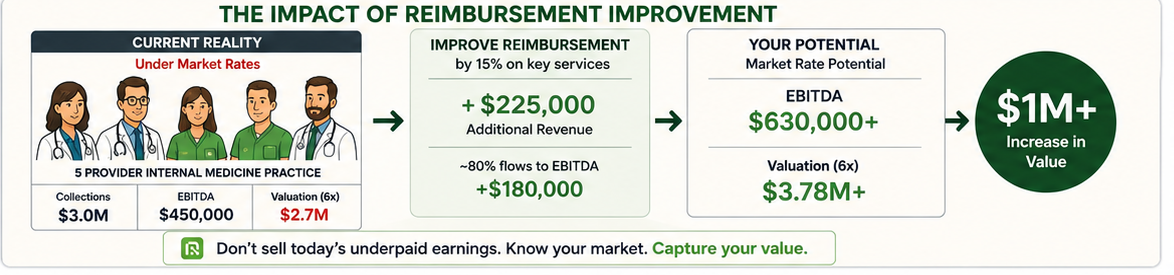
- Annual collections: $3.0 million
- Operating expenses: $2.55 million
- Current EBITDA: $450,000
- Proposed valuation multiple: 6x EBITDA
- Offer value: $2.7 million
At first glance, that may sound reasonable. A 6x multiple on current EBITDA produces a real number, and the owner may feel like the practice has reached a ceiling.
But then the practice runs a Reveon Health analysis report before signing the letter of intent.
The analysis shows that the practice is being paid meaningfully below local market levels on several high-volume commercial contracts. The issue is not a rare procedure or a small payer relationship. It is the everyday work that drives the business: established patient visits, new patient visits, annual wellness visits, and common office-based services.
Across the most important commercial payer contracts, Reveon estimates that the practice is roughly 15% to 20% below local market reimbursement for its core services.
That changes the conversation.
Assume $1.5 million of the practice’s annual revenue comes from the affected commercial contracts. If the practice improved those contracts by 15%, that would create roughly $225,000 in additional annual revenue.
Not all of that would necessarily become profit. There may be some additional billing costs, consulting costs, timing delays, or implementation friction. But because the practice already has the providers, staff, rent, EHR, and basic infrastructure in place, a large portion of improved reimbursement can flow through to EBITDA.
If 80% of that reimbursement improvement flows to EBITDA, the math looks like this:
- Current EBITDA: $450,000
- 15% reimbursement improvement on affected revenue: $225,000
- Estimated EBITDA impact at 80% flow-through: $180,000
- Adjusted EBITDA: $630,000
At the same 6x valuation multiple, the practice would no longer be worth $2.7 million. It would be worth approximately $3.78 million.
That is more than $1 million of potential value created by identifying and correcting under-market reimbursement.
And if the underpayment is closer to 20%, the impact is even larger:
- 20% reimbursement improvement on affected revenue: $300,000
- Estimated EBITDA impact at 80% flow-through: $240,000
- Adjusted EBITDA: $690,000
- Valuation at 6x EBITDA: $4.14 million
In that scenario, the same practice could be worth roughly $1.4 million more than the original offer implied.
This is why reimbursement intelligence matters during an equity conversation.
The buyer may already see this opportunity. They may be looking at the practice and thinking, “We can buy this business based on today’s depressed EBITDA, renegotiate payer contracts later, and capture the upside.”
That does not mean the buyer is acting unfairly. It means they are doing the math.
The practice owner should be doing the math too.
With Reveon Health data, the owner has a much stronger set of options. They may still decide to sell, but they can negotiate from a more informed position. They can ask for a higher valuation, an earn-out tied to reimbursement improvement, or a structure that shares the upside if the buyer improves payer contracts after closing.
Or the owner may decide not to sell yet. Instead, they may use the data to renegotiate key contracts, improve EBITDA over the next 12 to 24 months, and revisit a sale later from a stronger financial position.
The key point is simple: a practice should not be valued as if today’s reimbursement is permanent if the data shows that today’s reimbursement is below market.
That hidden reimbursement gap can be the difference between selling a practice at a fair price and selling the buyer an upside opportunity for free.
How Reveon Health Fits into the Process, Practically
Reveon Health is not a broker pushing deals but a strategic partner providing transparency and market data that empower practice owners to make informed decisions. It helps uncover hidden reimbursement opportunities and models specific turnaround plans focusing on payers, codes, and timelines — turning “sell or suffer” into multiple actionable paths.
Closing thought
Equity offers are not inherently good or bad. They are just offers. Sometimes they are generous. Sometimes they are opportunistic. Often they are both, depending on what you know.
And right now, the biggest knowledge gap for independent practices is reimbursement context. Not what you get paid in absolute dollars. But what you should be getting paid in your market, for your services, by your payers.
That is what Reveon Health brings to the table.
If you are going to sell, do it with your eyes open. If you are going to stay independent, do it with a plan that is rooted in data. And if you are going to negotiate, do not negotiate blind.
Reveon Health helps independent practices walk into these conversations informed, calm, and harder to discount. That is the whole game.
FAQs (Frequently Asked Questions)
What initial signs indicate that an independent medical practice might be approached for a partnership or acquisition?
Typically, it starts with seemingly innocent outreach such as emails from ‘strategic partners,’ LinkedIn messages expressing interest in your practice, or referrals from bankers introducing groups active in your specialty. These pitches often address real pain points like liquidity, administrative burdens, recruiting challenges, payer negotiations, and scaling opportunities.
Why is it crucial for independent practices to assess their reimbursement rates before considering a sale or partnership?
Because reimbursement rates directly impact EBITDA, which drives valuation multiples. Without clear data on whether your reimbursement is fair or undervalued compared to local market norms, you risk selling at a discount and missing out on potential upside embedded in your current reimbursement rates.
How does Reveon Health assist independent practices during equity or acquisition discussions?
Reveon Health leverages Transparency in Coverage informed market data to provide independent practices with actionable insights into local reimbursement benchmarks by payer and service. This enables practices to objectively evaluate their reimbursement health, quantify potential EBITDA improvements, and negotiate with defensible data rather than relying on intuition or incomplete spreadsheets.
What common misconception do practice owners have regarding tight margins and the decision to sell?
Many owners assume tight margins are solely due to operational inefficiencies and thus consider selling as the only solution. However, it’s vital to distinguish whether margin issues stem from operations or reimbursement. If margins are depressed due to below-market reimbursements, a buyer may improve rates post-sale and capture that upside—meaning owners might unknowingly sell at a discounted valuation without realizing the embedded value in reimbursement.
How does Transparency in Coverage data transform negotiation dynamics for independent practices?
Transparency in Coverage mandates payers publish machine-readable files of negotiated rates. When processed into usable benchmarks by tools like Reveon Health, this data stops guesswork by allowing practices to compare their reimbursements against local norms by payer, CPT code, and site of service. This clarity empowers owners with quantifiable evidence during negotiations, enhancing leverage and confidence.
What key questions should an independent practice ask before signing a Letter of Intent (LOI) for equity offers?
Practices should inquire: Are we under market on our highest volume services? Which services drive most revenue and how do their reimbursements compare locally? Is our margin problem operational or reimbursement-related? What would improving reimbursements realistically do to EBITDA? If we fix reimbursement issues internally, do we still need to sell? And if we do sell, how should the potential upside be reflected in price or earn-out terms?